I often come across interesting posts on social media or receive emails from friends that I think are worth sharing with others in the native plant community. My hope is to provide some insights into various topics that will spark your interest or perhaps answer some nagging questions. In this first blog of what may become a new series, I’ll share some recent information that has reached my inbox or appeared in my social media feeds. Having been on my journey for over five years now, I am especially interested when folks share their thoughts or findings after several years of planting natives.
Latest Newsletter from Margaret Roach
In an email I received today, a chapter member wrote, “I’m sharing this email from gardening writer Margaret Roach because it has oodles of information in it on a range of topics relating to planting and cultivating native plants. There’s probably something for each of us here. 😊”
This jam packed newsletter indeed has something for everyone, including:
- going native: the ‘gardening for nature survey’ results, with tom kaye
- winter sowing of native plants, with heather mccargo
- garden to support birds: a webinar with desirée narango
- recap: our native ‘weeds’
- the november garden chores
- in ‘the new york times’: what to know before you build a greenhouse
And if that’s not enough, you can browse the entire archive of Margaret Roach’s podcast at this link or peruse the full list of topics that she’s covered in the New York Times at this link.
Why more people are turning to native gardens in D.C.
Speaking of press coverage of native plants, in this recent article in the Washington Post, the reader is introduced to “DC Natives, a nonprofit that aims to inform communities in the District about native plants — part of a small but growing movement in the D.C. area to bring indigenous species to more gardens and green spaces.”
Jeremy Tidd, owner of Bona Terra Nursery, was interviewed for the article. Jeremy “agreed that there is a growing interest in native planting and that people are excited to learn about native gardening, but he said there is much more work to do…. the vast majority of people, they just want to go to the plant store that’s the closest and get whatever’s blooming and whatever’s pretty,’ he said. ‘… What I see in a lot of the movement is they’re reaching the people that are interested, and we are not reaching the mass public, which is going to be harder to get to because they’re not looking for it.'”
So more than ever, there is a growing need to spread the Wild Ones vision of native plants and natural landscapes thriving in every community. The challenge is how do we reach the people who are not already aware and interested in native plants?
Why is designing with native plants so hard?
A design challenge I experienced first hand in a local native garden was allowing a Canada goldenrod (Solidago canadensis) that volunteered a year ago to remain. Fast forward, and this year sections of the garden were being overrun by Canada goldenrod.
We failed to understand two concepts that have been overlooked and under appreciated in native garden design: 1) plant survival strategies and 2) plant sociability index. Plant survival strategies involve which plants like disturbance, the tolerances plants have, and which will outcompete others under preferred conditions. Plant sociability refers to how a plant actually lives its life. “How gregarious is this species? Will it reproduce by seed or rhizome? How easily? How far? How does soil type and moisture level and sunlight affect that gregariousness? Is it an early succession species that will only be around for a few years?” ~ Benjamin Vogt
Plant Survival Strategies
The Science of Plant Survival Strategies introduces readers to Grimes’ Triangle. Based on their response to stress and disturbance, plants are classified into three broad categories: competitors (plants that rule when stress and disturbance are low), stress-tolerators (plants that take tough growing conditions in stride), and ruderals (plants that are short-lived and pop up when the odds are favorable for growth).
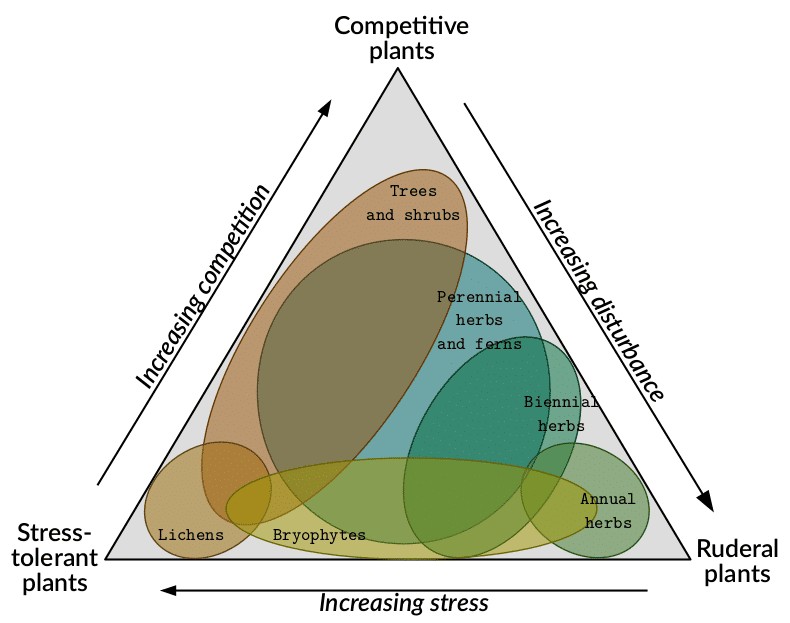
Understanding and gardening with these plant survival strategies in mind will help you become a better gardener, and the author offers the following list of strategies for creating an environment that welcomes a broader plant palette:
- Water less and fertilize less. In a world in which water restrictions abound and fertilizer is expensive, conserving these resources can be a welcome goal.
- Plant in a 4- to 6-inch layer of gravel or sand. Coarse grit that is low in fertility and that has few fine particles reduces weed growth and creates conditions that certain stress-tolerators need to thrive.
- Practice shallow cultivation. You can reduce weed pressure and too many ruderals by shallowly cultivating the top few inches of soil. This disturbance helps deplete the weed seed bank.
- Become the bison and disturb the plants. It’s OK to go into a garden bed and break up the edges of some competitors to slow their spread. This will open up new space for ruderals to pop up.
- Try some late-spring cutbacks. Chopping back vigorous asters (Symphyotrichum spp. and cvs.) and perennial sunflowers (Helianthus spp. and cvs.) in spring will keep their competitive growth in check.
“As you experiment with these strategies, be patient. Often with reduced fertility and water plants will grow more slowly. Prepare yourself mentally to see some reduced vigor, and be open to noticing what happens next.” ~ Dr. Jared Barnes, Author
Plant Sociability Index
In his blog on Sociability Rankings, Benjamin Vogt states that “Learning about sociability — how a plant actually lives its life — is a critical aspect most folks either ignore or don’t know about or don’t take the time to study.” He describes a plant’s sociability rating on a scale of a 1-4 score based on how much the plant spreads or reproduces (by seed, roots, or both). However, these are not hard and fast rankings and “can be tempered or accelerated based on environmental factors such as soil type, available moisture, light, and the other plants within the community. Here’s how that ranking system [by Vogt] goes:
- a clumper that slowly expands over time
- a light sower, moderate-root runner, may create small groups of plants or new plants may pop up sparsely here and there.
- larger masses of plants that develop more quickly, and / or may create those same masses in more areas of the landscape.
- a species that, if given ideal habitat, will dominate other species and perhaps the landscape over time.”
In his blog on What is Plant Sociability?, Jared Barnes “add[s] descriptors to sociability levels—very low (1), low (2), medium (3), high (4), and very high (5). I think that it helps amateurs better think through whether their plants should be treated as loners [1], light minglers [3], or gregarious party animals [5].”
So in the case of the Canada goldenrod volunteer that we allowed to grow at will in the garden, had we known it was a strong competitor with a sociability rating of 4 or 5, based on which scale you use, we probably would have removed the individual plant as soon as we identified it rather than let it grow for a year and have to deal with the massive numbers that grew from seed and by the plants’ rhizomes. They are incompatible with the intended design and biodiversity we hope to achieve and maintain in the garden.
It’s hard to find information on a plant’s sociability rating, but while researching for this blog, I ran across the Wild Ones Tennessee Valley’s blog, What is plant sociability?, and their Native Plant Profiles, which contain sociability ratings.
Wildly appreciative of the opportunity to learn from and share with others,
Marlene Smith, President, Wild Ones Chesapeake Bay
Wild Ones Chesapeake Bay is deeply rooted in native plants and cultivating partnerships, while striving to educate, advocate, and collaborate to connect people and native plants for a healthy planet. Our vision is native plants and natural landscapes thriving in every community. Check out our Events page, Google calendar, Facebook, and/or Instagram for our upcoming events. And don’t forget to subscribe to our new YouTube channel and email subscriber list!
