The is the second post in a 3-post series inspired by the recommendations of Shaun McCoshum, in which he inspires us, as stewards of the land, to shift our focus from doing no harm to doing least harm when managing our yards. In our first post, we presented McCoshum’s ideas and discussed the 50 degree (50F) rule.
Managing Stems
Ok, so now that we have a better understanding of the 50F rule and that we should attempt to do least harm, what’s the best practice for managing stems for stem-nesting bees? While the gardening practice is a modern conservation movement, the behavior itself is an ancient evolutionary adaptation among plants and insects. Long before human intervention, over 4,000 species of North American native bees evolved to use natural cavities—such as those created by wood-boring beetles or hollowed-out pithy plant stems—for laying their eggs. Many ecological gardeners leave the stems intact with their seed heads during the winter to provide food for overwintering birds. But when spring arrives, some gardeners prefer to cut back the stems to reduce what may be considered a messy look. And that’s ok. Cutting back stems intentionally has not only aesthetic benefits but can also provide habitat for stem nesting native bees. According to McCoshum: “Stem cutting can be done at any temperature because the insects inside are immobile. So, a single cut may go through a cell of a nest, but it will leave other cells intact. Keeping material on site will allow for pupa to emerge and eggs to hatch. The closer cut material is to the plant it was cut from, the better chances for young herbivores to find the host plant again.”
So we can cut back plant stems at any temperature, but when is the best time to cut down stems? The Tufts Pollinator Initiative suggests “at least two years (ideally never),” and to explain why, they review bee and plant biology.
Year 1: Plant stems are growing. Native plants like joe-pye weed, elderberry, wild bergamot, mountain mint, and swamp milkweed produce hollow or pithy (e.g. soft, spongy tissue) stems suitable for nesting bees. Bees won’t nest in these actively growing stems. At the end of the growing season (December through March), cut the stems back to between 6-18” tall. Use sharp tools to ensure a clean cut. By cutting back the stems, you have created homes for next year’s bees.
Year 2: Bees active during this year will nest in the stems you left standing. They will lay eggs in the stem and provision each egg with a nutritious ball of pollen and nectar. Inside the stem, bees will develop from eggs into larvae and adults that hibernate through winter. Bees won’t emerge from stems until next growing season. Remember to cut back the new, green stems produced this year for next year’s bees.
Year 3: In spring of year 3, stems produced in year 1 still contain bees; stems produced in year 2 do not contain bees. Leave both generations of stems standing throughout the year. Spring-active bees will emerge from year 1 stems by June, whereas fall-active species might not emerge from year 1 stems until August or early September. During this time, new bees will nest in year 2 stems, so leave them standing!
While this may seem like an awfully long time to leave stubble in a garden, it is the only way to ensure that native bees find safe, undisturbed places to nest. Posting signage in your garden to inform visitors about how gardens can be managed to balance aesthetic and ecological goals can be helpful. Source: Tufts Pollinator Initiative
The important takeaway: Cut back stems at the end of the growing season (December-March to do least harm).
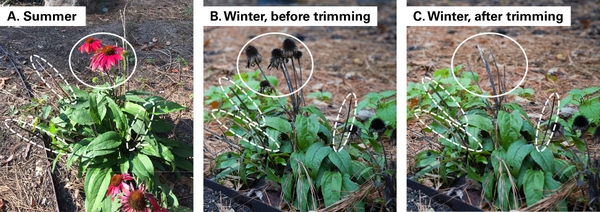
Cutting stems back at the end of the growing season (December-March) is further supported by research published in 2025 by North Carolina State University, in which they provide details of their extensive study in which Extension agents and Master Gardener volunteers sampled stems from 20 gardens in 10 counties across North Carolina. Nearly 3,000 stems in all were collected four times of year (winter, spring, summer, and fall). Although only about 1.5% of stems contained nests, there were clear seasonal differences. The results of this study showed that stems are not occupied in their first winter, so this is a good time to trim them. Or you can leave the seed heads in place long enough to feed the birds.
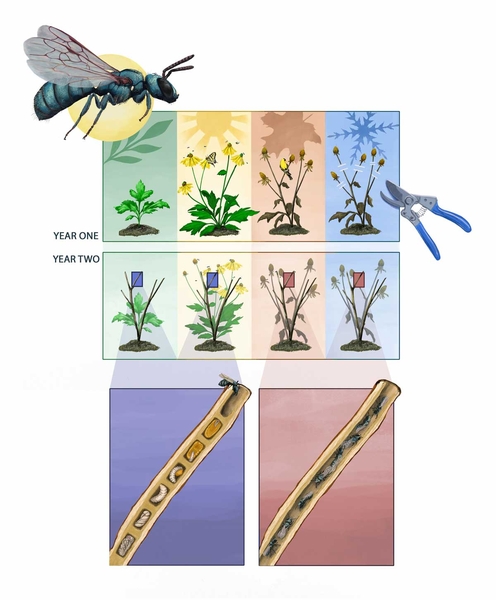
Seasonal cycle of stem growth in a perennial plant. In year one, flowering stems grow and die. If they are trimmed in their first winter, they are available as nesting and overwintering habitat throughout the following year—shown here with small carpenter bees in the genus Ceratina.
Illustration by Christina Spence Morgan CC BY-NC-ND 4.0
The North Carolina State University research study is packed with lots of great information, including Background on Perennial Stems as a Resource for Pollinators; Stems Through the Seasons: Results of the Study; When to Cut Back Dead Stems; How Much to Trim; What to Plant; Who Lives Inside; Frequently Asked Questions; and Related Resources.
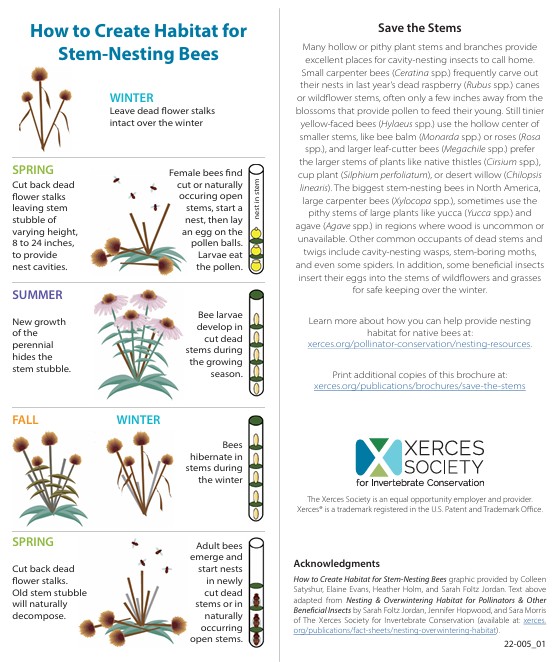
For more information on stem management, check out the Xerces’ publication Nesting and Overwintering Habitats for Pollinators and Other Beneficial Insects, which includes the graphic How to Create Habitat for Stem-Nesting Bees, designed by Heather Holm, a biologist, pollinator conservationist, and award-winning author in collaboration with Elaine Evans and Colleen Satyshur (UMN Bee Lab) and Sarah Foltz-Jordan (Xerces Society).
Choose Wisely – Manage Stems with Intentionality
So what will you do this spring? I encourage you to garden with intentionality and take steps to protect biodiversity, including the native plants, pollinators, and wildlife that need our help. Realize that our native habitats are all unique, and we need to do what’s best for the spaces we’ve created by weeding through the social media hype. Shift your focus from no harm to least harm when managing your yard, and understand your “role as a steward of the land is to be the absent animals and processes that sculpt spaces into beautiful spaces that are essential to wildlife.” ~ Shaun McCoshum
Read the additional blogs in this series:
Wild Ones Chesapeake Bay is deeply rooted in native plants and cultivating partnerships, while striving to educate, advocate, and collaborate to connect people and native plants for a healthy planet. Our vision is native plants and natural landscapes thriving in every community. Check out our Events page, Google calendar, Facebook, and/or Instagram for our upcoming events. And don’t forget to subscribe to our new YouTube channel and email subscriber list!
